

Cat Body Condition Score (BCS): 5 Insights to Keep Your Cat at a Healthy Weight
Understand your cat's Body Condition Score (BCS) and learn how to assess weight, adjust dry food portions, and support long-term feline health
In Short
The cat Body Condition Score (BCS) is a standardized 1-9 scale that evaluates fat distribution and muscle mass through visual and tactile assessment. It helps identify whether a cat is underweight, overweight, or in ideal condition, and in some cases, it could be far more accurate than weight alone. This tool is helpful when adjusting dry cat food intake, guiding feeding plans, and preventing obesity-related disease.
What is a Body Condition Score (BCS)?
The body condition score (BCS) is a veterinary tool developed by researchers at Nestlé Purina and later adopted by veterinary organizations such as WSAVA and AAHA to assess a cat's fat stores and muscle mass.
The most widely used version is the 9-point cat body condition score, where 1 represents emaciation, and 9 represents severe obesity. A score of 5 indicates an ideal condition.
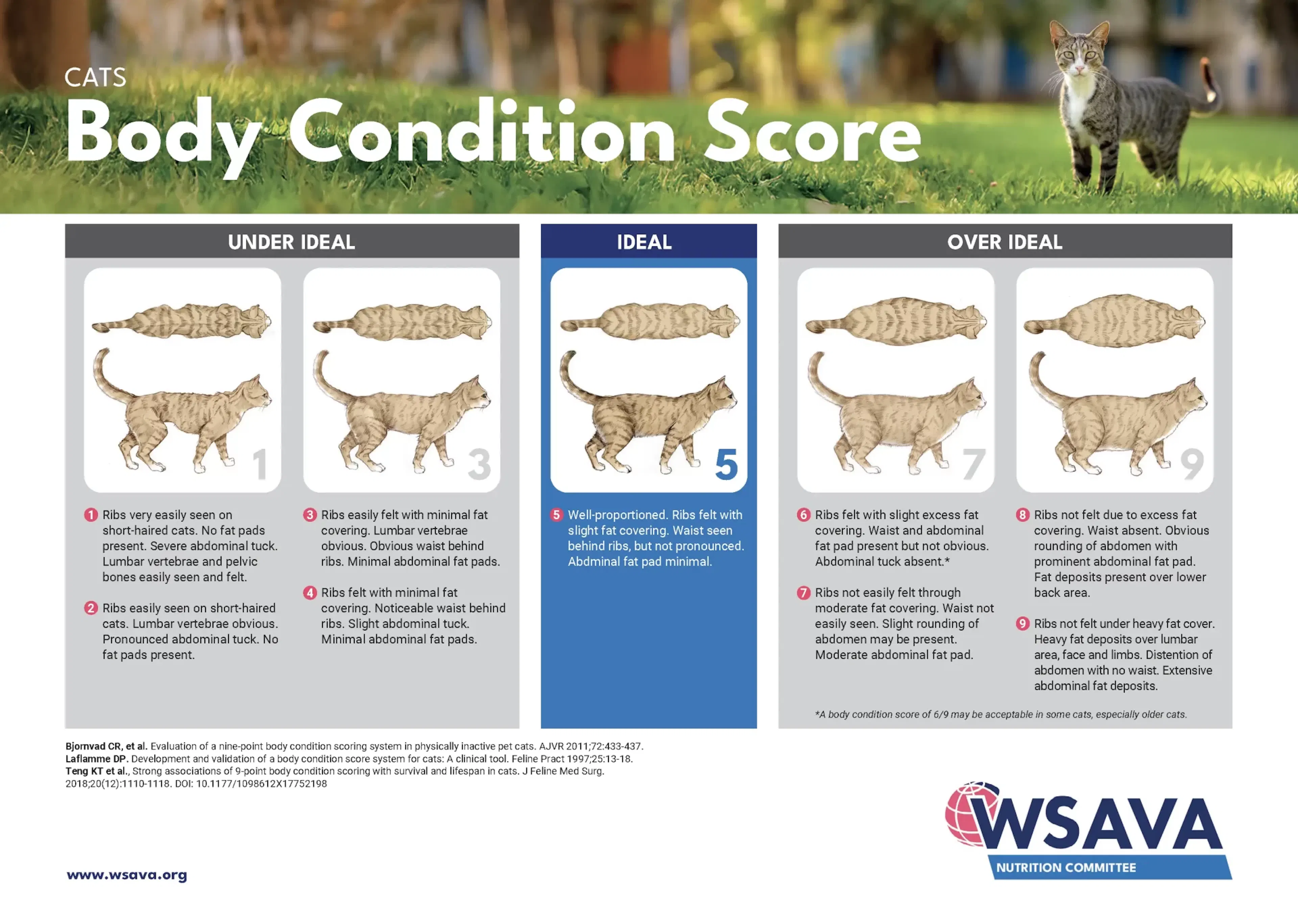
Body Condition Score chart for cats, as published by WSAVA (World Small Animal Veterinary Association)
Unlike simply weighing your cat, the body condition score considers fat pads, abdominal tuck, rib coverage, and muscle tone. These physical indicators offer a more accurate picture of your cat’s health than the number on the scale. It reflects both body structure and muscle mass, especially in aging cats or those with chronic conditions.
Body Condition Assessment or How do I use BCS?
Body condition scoring is a skill anyone can learn with practice. Monthly checks help monitor trends and intervene early when needed.
-
Look from above Does the cat have a visible waist behind the ribs? A rounded body with no tapering may indicate excess fat or a high condition score.
-
Look from the side Is there a slight abdominal tuck behind the ribcage? A sagging belly with no tuck suggests an overweight condition. A severe abdominal tuck with visible bones might indicate a cat that’s under ideal body condition.
-
Feel the ribs The rib area is one of the most revealing BCS indicators. Run your fingers across the ribcage. In an ideal cat, ribs are easily felt with minimal pressure. If they’re hard to find or you have to press firmly to feel the ribs, the fat covering is excessive. If you feel every rib too sharply or see pelvic bones, especially with no abdominal tuck, there may be minimal fat or muscle loss. In a healthy cat, these bones should be easily felt beneath a thin layer of fat, but not prominent. A very narrow waist may also indicate nutritional deficits.
-
Feel the spine and hips Spinal bumps, bony hips, or a flat abdomen also indicate a suboptimal condition. These signs should prompt dietary and health evaluation, particularly if combined with reduced fat pads or low energy levels. The bones should be palpable beneath a thin layer of fat. Sharp edges may indicate muscle loss; a thick layer may indicate obesity. Pay attention to the fat layer consistency along the spine and rear.
-
Evaluate fat pads Check the lower belly (primordial pouch), tail base, and hind legs. Excessive fat deposits here can shift a score from 5 to 6 or beyond. A large, swinging pouch often indicates excess fat accumulation.
-
Compare to a BCS chart Use a visual guide to match your cat’s physical traits to the correct condition score.
Over time, this process becomes faster and more accurate. Use the same method monthly and record changes to track progress. Monitoring your pet’s body condition score over time supports long-term health.
In long-haired cats, tactile checks are essential because fur can conceal changes in shape. Pay attention to areas like the hind legs, fat pad development, and spine definition. Subtle shifts in these regions can signal early weight gain, muscle loss, or excess fat that isn’t yet reflected in body weight.
What Should Be My Cat’s Ideal Body Weight?
There is no universal ideal weight for cats. A healthy weight for a slender Oriental breed may be 7 lbs, while a muscular Maine Coon might be ideal at 16 lbs. That’s why the body condition score is the preferred tool to assess the cat's ideal body weight.
Here’s how the condition score maps to weight deviation:
-
BCS 3 or below = significantly underweight
-
BCS 4 = ~10% under ideal
-
BCS 5 = Ideal condition
-
BCS 6 = ~10–15% overweight
-
BCS 7 = ~20–30% overweight
-
BCS 8–9 = 30%+ overweight
Example: A cat weighing 12 lbs at BCS 7 may need to reduce to around 9.5–10 lbs to reach the ideal weight.
Cats with a BCS of 7–9 should have their weight reduction supervised by a veterinary team to ensure it is gradual and safe. The presence of an extensive abdominal fat pad or reduced mobility should be taken seriously, especially if the cat is severely overweight.
If a dietary change is required, gradually switching to dry cat food helps reduce the risk of digestive upset and improves transition success.
Maintaining a Healthy Body Condition
Maintaining ideal body condition protects against chronic illness, improves mobility, and extends lifespan. Cats at BCS 5 show a visible waistline, a slight abdominal tuck, and easily felt ribs beneath a thin layer of fat.
Excess body fat contributes to diabetes, osteoarthritis, hepatic lipidosis, and decreased life expectancy. Early intervention using the body condition score helps avoid these risks before they develop. A cat with a healthy body condition and muscle mass has a better chance of reaching senior age without mobility decline or complications from excess fat.
How BCS Relates to Dry Cat Food
The body condition score is a foundational tool when evaluating and adjusting dry cat food intake.
Dry foods vary widely in caloric density, macronutrient composition, and feeding instructions, which often rely solely on weight. BCS gives a more individualized view of nutritional needs by focusing on muscle mass, fat pad thickness, and abdominal shape.
Cats with a BCS above 5 may require energy-restricted dry formulas with reduced fat and added fiber to decrease fat pads while preserving lean muscle. Cats below BCS 4 need high-protein, energy-dense diets to support safe weight gain and rebuild muscle mass.
Routine BCS checks help refine portion sizes, assess if a current formula supports ideal weight, and reduce reliance on generic feeding tables. Especially for indoor cats, who are more prone to overfeeding and developing excess fat, BCS is a helpful feedback loop that makes dry food nutrition more precise and effective.
Frequently Asked Questions
A fat chart visually displays each level of body condition score and helps pet owners compare their cat's shape to standard body condition score silhouettes used by vets.