

Is My Cat Overweight? A Complete Guide to Healthy Cat Weight
Learn how to tell if your cat is overweight or underweight, understand the health risks of feline obesity, and get a vet-backed plan for safe weight loss - including tips for multi-cat households.
In Short
A healthy cat weight isn't a single number - it's a range shaped by breed, sex, frame size, and muscle mass. The scale alone can mislead you: a 4 kg Siamese and a 7 kg Maine Coon can both be perfectly healthy. This guide explains how to assess your cat's weight at home, what the health risks of obesity and underweight actually look like, and how to address both safely - including the notoriously difficult problem of managing weight when you have more than one cat.
What Does a Healthy Cat Weight Actually Look Like?
Most people assume there's a universal "healthy" number for cats - something like 4 kg or 9 lbs. There isn't. Weight is one input, not a verdict.
The factors that determine a healthy weight for your specific cat include:
-
Breed - A domestic shorthair, a Maine Coon, and a Siamese have completely different healthy ranges (see below).
-
Sex - Intact males tend to be larger than females of the same breed. Neutered cats often have lower metabolic rates, which changes their caloric needs.
-
Frame size - Two cats of the same breed and sex can have different healthy weights based on bone structure.
-
Muscle mass vs. fat - A muscular cat and a fat cat can weigh the same. Weight doesn't tell you which is which.
This is why a number on a scale, while useful as a tracking tool, is never the full picture on its own.
Why the Scale Alone Can Mislead You
A 5 kg cat might be perfectly healthy, mildly overweight, or dangerously obese - depending entirely on what that 5 kg is made of and on what frame it sits. The most reliable way to assess body composition is Body Condition Scoring (BCS), a standardized physical evaluation system used in veterinary practice.
Body Condition Score (BCS) assigns a number from 1 to 9 (or 1 to 5 in some systems) based on rib coverage, waist definition, and abdominal tuck. It is a better indicator of whether your cat is at a healthy weight than the scale alone. Use both together for the clearest picture.
Do Breed and Sex Affect Weight Standards?
Yes, significantly. Here are some examples for general healthy weight ranges by breed:
| Breed | Typical Healthy Weight |
|---|---|
| Domestic shorthair / mixed breed (female) | 3.5 – 5 kg (7.7 – 11 lbs) |
| Domestic shorthair / mixed breed (male) | 4 – 6 kg (8.8 – 13 lbs) |
| Siamese | 3 – 5 kg (6.6 – 11 lbs) |
| Maine Coon (female) | 4 – 7 kg (8.8 – 15.4 lbs) |
| Maine Coon (male) | 6 – 9 kg (13.2 – 19.8 lbs) |
| Persian | 3.5 – 5.5 kg (7.7 – 12 lbs) |
| Ragdoll | 4 – 9 kg (8.8 – 19.8 lbs) |
These are general ranges, not diagnostic thresholds. A Maine Coon at 8 kg may be perfectly healthy; a domestic shorthair at 8 kg is likely obese. Always interpret weight alongside BCS and your vet's assessment.
How to Tell If Your Cat Is Overweight (or Underweight)
You don't need a vet visit or any equipment to do a basic physical assessment. The three checks below work for both directions - too heavy and too light.
Abdominal tuck (from the side): Looking from the side, the belly should rise slightly behind the ribcage rather than hanging level or sagging downward. A pendulous or low-hanging belly (beyond the primordial pouch - see below) is a sign of excess fat.
Waist check (from above): Look down at your cat while they're standing. There should be a visible narrowing behind the ribcage - a defined waist. A cat with no waist, or whose body is wider at the belly than the ribs when viewed from above, is likely carrying excess weight.
Rib check (most important): Place your hands along both sides of your cat's ribcage with light pressure. You should be able to feel individual ribs with minimal effort - like feeling your knuckles through a thin glove. If you have to press firmly to feel anything, there's too much fat covering. If the ribs are immediately prominent with no padding at all, your cat may be underweight.
The Primordial Pouch vs. Actual Fat
Many owners mistake the primordial pouch for obesity. The primordial pouch is a natural, loose flap of skin and fat that runs along a cat's lower abdomen - it swings when they walk and is present in cats of all weights, including very lean ones.
How to tell the difference:
-
Primordial pouch: Soft, loose, swings when walking. Located on the lower belly between the hind legs. Present in lean cats.
-
Excess abdominal fat: The entire belly is thick and round, not just a flap. The cat fails the rib and waist checks above. The pouch may also be present, but the overall abdominal mass is the issue.
A cat with a large primordial pouch and clear ribs is not overweight. A cat that fails the rib check is overweight regardless of pouch size.
How to Weigh Your Cat at Home
You need two things: a bathroom scale and a few minutes.
Weigh yourself alone
Step on the scale and note your weight. Write it down - don't trust memory.
Pick up your cat
Hold your cat securely. Some cats cooperate better wrapped in a towel; do whatever works safely.
Weigh yourself holding your cat
Step back on the scale while holding your cat. Note this second number.
Subtract
Your cat's weight = (weight with cat) minus (your weight alone). That's it.
Record and date it
Write it down with the date. Weight tracking only becomes useful over time. A single reading tells you where your cat is today; a series of readings tells you which direction they're moving.
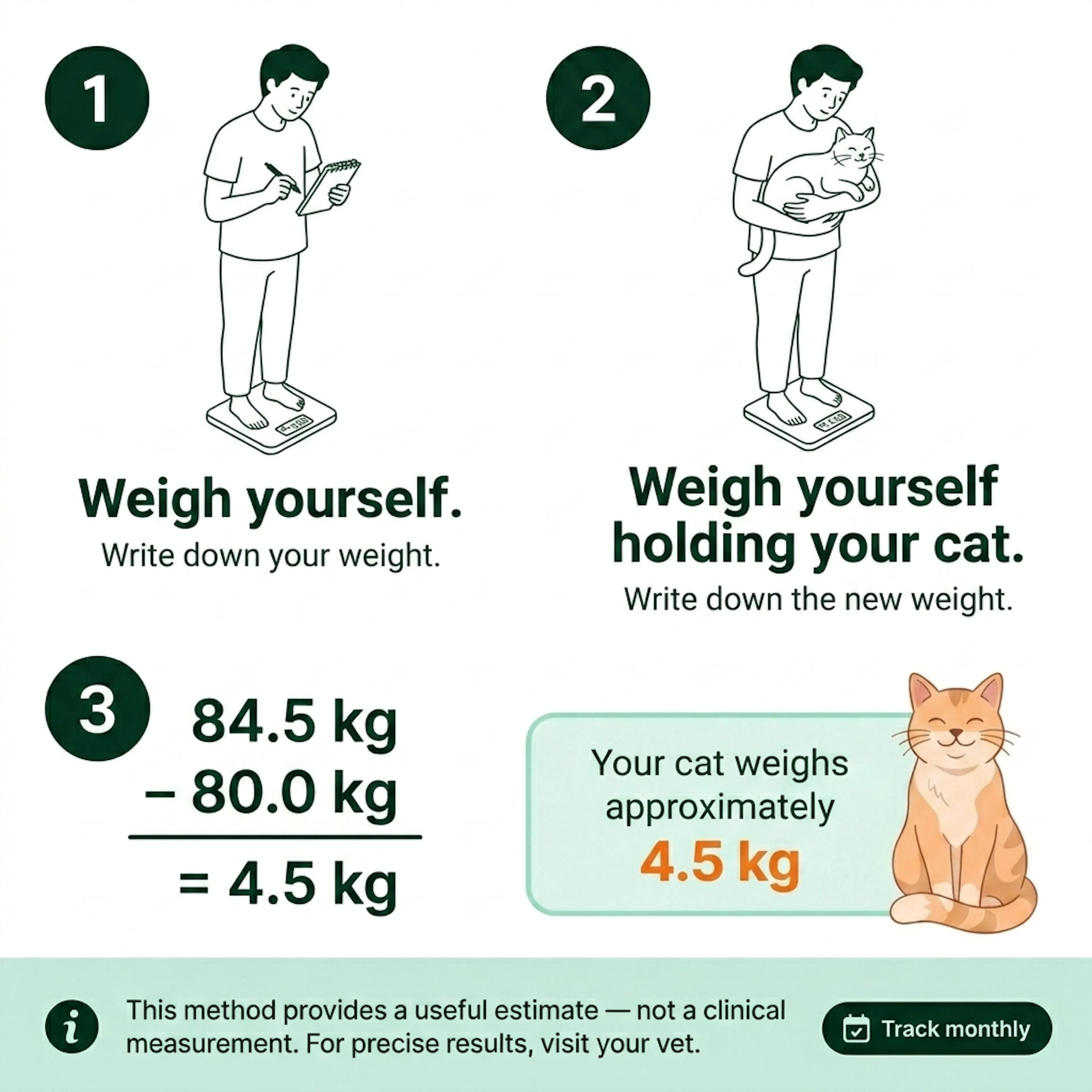
For the most accurate readings, weigh your cat at the same time of day (before feeding) and on the same scale. A 0.1 kg difference between morning and evening is normal - what matters is the trend over weeks and months.
Reading a Cat Weight Chart
Weight charts give you a general reference range, not a verdict. Use them as a starting point, then apply the physical checks above.
| Body Type | Female | Male |
|---|---|---|
| Small-framed / fine-boned | 2.5 – 3.5 kg (5.5 – 7.7 lbs) | 3 – 4.5 kg (6.6 – 9.9 lbs) |
| Average / medium-framed | 3.5 – 5 kg (7.7 – 11 lbs) | 4 – 6 kg (8.8 – 13.2 lbs) |
| Large-framed / big-boned | 5 – 6 kg (11 – 13.2 lbs) | 5.5 – 7 kg (12 – 15.4 lbs) |
Numbers above these ranges aren't automatically a problem for large breeds (Maine Coon, Ragdoll, Norwegian Forest Cat), and numbers at the lower end of a range aren't automatically a problem for fine-boned breeds (Siamese, Oriental). The chart is a reference, not a diagnosis.
What Are the Health Risks of an Overweight Cat?
Excess weight isn't a cosmetic issue in cats. The health consequences are well-documented and directly tied to lifespan.
-
Type 2 diabetes - Obese cats are four times more likely to develop feline diabetes mellitus. Excess fat causes insulin resistance; the body produces insulin, but cells stop responding. Many cats achieve diabetic remission after weight loss, but the condition is serious and expensive to manage.
-
Feline hepatic lipidosis (fatty liver disease) - When an overweight cat stops eating - even briefly - the body mobilizes fat stores faster than the liver can process them. Fat accumulates in liver cells, impairing function within 2–7 days. Without treatment, it can be fatal.
-
Osteoarthritis and joint disease - Extra weight increases mechanical load on joints. Studies show obese cats have significantly higher rates of arthritis, particularly in the hip and elbow. Arthritic pain then reduces activity, which worsens weight - a compounding cycle.
-
Reduced lifespan - Overweight cats live measurably shorter lives than lean cats. Even moderately overweight cats (BCS 6–7/9) have a reduced life expectancy compared with cats at BCS 4–5/9.
-
Cardiovascular strain - The heart works harder to circulate blood through excess tissue. Over time, this contributes to hypertension and cardiac hypertrophy, particularly in older cats.
-
Grooming impairment - Overweight cats cannot reach all parts of their body. This leads to matting, skin infections, and perianal hygiene problems. A cat that stops grooming its hindquarters is often struggling with weight, not just being lazy.
-
Urinary tract disease - Obese cats have higher rates of FLUTD, cystitis, and urinary blockages, particularly in males.
My Cat Gaining Weight But Not Eating More?
This is one of the most common and most confusing situations for cat owners. The cat seems to eat the same amount it always has - yet the weight keeps climbing. Here's why.
Metabolic slowdown after neutering. Spayed and neutered cats have lower metabolic rates than intact cats - studies suggest a 20–30% reduction in energy requirements after the procedure. A cat that needed 250 kcal/day before neutering may only need 175–200 kcal/day after. If the feeding amount doesn't change, gradual weight gain is almost guaranteed.
Age-related changes. Cats between 2 and 10 years old are in their "settled" adult phase - lower activity, stable routine, easy to overfeed. Senior cats (10+) may have metabolic shifts in the other direction, losing weight despite adequate intake.
Calorie density of dry food. Dry cat food is energy-dense by design. A small extra scoop per day - 20 extra kibbles - can add up to hundreds of extra calories per week over months. Free-feeding makes this particularly hard to detect, because intake is rarely measured.
Indoor sedentary lifestyle. An indoor-only cat may cover very little ground in a day. Unlike outdoor cats who patrol territory, climb, and hunt, indoor cats often sleep for 16+ hours. Activity expenditure is low; calorie intake needs to match that.
What to do: The first step is measuring what your cat actually eats - weigh food in grams, not estimate by cup. Review Calories and Metabolizable Energy to understand how to calculate your cat's actual energy needs, and Crude Fat to understand how fat content drives calorie density.
My Cat Is Losing Weight But Still Eating Normally
When a cat eats but loses weight, the body is processing nutrients incorrectly - either absorbing too little, burning too much, or both. This is a medical issue, not a feeding problem.
Unexplained weight loss in a cat that is still eating is almost always caused by an underlying medical condition. See a veterinarian. Bloodwork - including a thyroid panel - is usually the most efficient first step and will identify the most common causes quickly.
Hyperthyroidism is the most common cause in cats over 10. An overactive thyroid floods the body with thyroid hormone, dramatically accelerating metabolism. These cats often eat more than usual - not less - but continue losing weight because they're burning energy faster than they can take it in. Other signs include restlessness, increased vocalization, and a rough coat.
Feline diabetes can cause similar patterns - the body cannot process glucose normally and turns to fat and muscle for fuel instead. Early diabetes often presents with increased appetite, increased water intake, and gradual weight loss.
Intestinal parasites (roundworms, tapeworms, Giardia) interfere with nutrient absorption. A cat can eat adequate food and still be malnourished if their gut cannot absorb what they're eating. More common in cats with outdoor access or hunting habits.
Dental pain is often missed because affected cats still approach the bowl and spend time near food - they just consume less than it appears because chewing is painful. Look for dropped food, chewing on one side, or reluctance to eat hard kibble.
Inflammatory bowel disease (IBD) damages the intestinal lining over time, reducing the gut's ability to absorb nutrients. Chronic intermittent vomiting, loose stools, and slow progressive weight loss are common signs.
Stress and competition in multi-cat households can cause a lower-ranking cat to eat less than it appears to. If you're not watching every cat eat its full portion, you may be overestimating how much one particular cat actually consumes.
Sarcopenia (age-related muscle loss) in cats over 12 causes gradual loss of lean body mass even with adequate caloric intake. This is a normal aspect of aging in geriatric cats but can be worsened by reduced protein absorption.
When to act quickly: If your cat loses more than 10% of its body weight over a short period, stops eating entirely for 24 hours or more, or shows other symptoms (vomiting, diarrhea, lethargy, increased thirst or urination), do not wait. These are same-week or same-day vet situations.
How Much Should I Decrease Food After Spay/Neuter?
This is worth its own answer because the timing and magnitude matter.
Spay/neuter surgery reduces metabolic rate by an estimated 20–30% in most cats. This change begins quickly - within weeks of the procedure. A cat that was being fed appropriately before surgery is now being overfed on the same amount.
The practical guidance:
-
Reduce daily calorie intake by 20–25% after surgery.
-
This usually means reducing the amount of food, not switching to a "light" formula (though calorie-dense foods can be replaced with lower-calorie options).
-
Kittens neutered at 4–6 months may still need relatively high-calorie food for growth - consult your vet about timing the reduction correctly.
-
Weigh your cat monthly after surgery. The weight gain associated with neutering typically becomes visible within 3–6 months if intake isn't adjusted.
How to Help an Overweight Cat Lose Weight Safely
The goal is steady, slow, sustainable. Feline weight loss is measured in months, not weeks. Trying to accelerate the process is one of the most dangerous things you can do for a cat.
How Fast Should a Cat Lose Weight?
Never put a cat on a crash diet or restrict food severely to speed up weight loss. An overweight cat that stops eating - even for 1–2 days - is at serious risk of hepatic lipidosis (fatty liver disease), a potentially fatal condition caused by the liver becoming overwhelmed with mobilized fat. The risk is highest in obese cats.
The veterinary consensus on safe weight loss rate:
-
0.5% to 2% of body weight per week is the accepted safe range (APOP, VCA, peer-reviewed veterinary literature).
-
The practical target for most cats: approximately 1% per week, which equals roughly 0.5 lbs (0.23 kg) per month for a 10 lb cat, or 0.9 lbs (0.41 kg) per month for an 18 lb cat.
-
The APOP clinical framework targets approximately 2–3.5% of body weight per month as a safe monthly rate.
-
If your cat loses more than 2% of body weight per week, increase calories by 10% and contact your vet.
-
If your cat hasn't lost any weight after 4–6 weeks, the calorie calculation needs to be revised - not the approach abandoned.
Some cats plateau for 2–4 weeks before weight loss resumes as the metabolism adjusts. This is normal. Do not dramatically cut calories in response to a plateau.
How Many Calories Does My Cat Need to Lose Weight?
Calorie calculation for weight loss starts with Resting Energy Requirement (RER):
RER (kcal/day) = 70 × (ideal body weight in kg)^0.75
For weight loss, most vets recommend feeding 80% of RER calculated to the cat's target weight (not current weight). This creates a controlled calorie deficit without pushing the cat into starvation territory.
A 7 kg cat with an ideal weight of 5 kg, for example:
-
RER for 5 kg = 70 × (5)^0.75 ≈ 70 × 3.34 ≈ 234 kcal/day
-
Weight loss target: 80% × 234 = approximately 187 kcal/day
Do not feed below 70% of RER without veterinary supervision. Going too low is dangerous and counterproductive - cats reduce activity to compensate, making weight loss harder.
See Calories and Metabolizable Energy for how ME values are calculated and how to compare foods.
Dry Food vs. Wet Food for Weight Loss
This is genuinely more complex than "wet food is always better."
Wet food advantages: Higher moisture content increases satiety and volume without adding many calories. Cats tend to feel fuller on wet food. Lower calorie density per gram makes portion control easier.
Dry food advantages: Calorie content is clearly listed and easier to measure precisely (by a gram scale). Some cats won't eat wet food. Some weight-loss formulated dry foods are designed with appropriate protein-to-calorie ratios.
The real issue with dry food and weight: Standard dry cat food is calorie-dense - typically 300–450+ kcal per 100g of dry matter. Free-feeding dry food to a sedentary indoor cat is a reliable way to produce slow, steady weight gain over months and years. It's not that dry food is inherently fattening - it's that high calorie density combined with unmeasured free access makes portion control very hard.
If you're keeping your cat on dry food during a weight loss program, weigh every portion on a gram scale. Measuring by cup or by visual estimate is not accurate enough. See Crude Fat for how to compare energy density across products.
Adjusting What Your Cat Eats
Three nutritional principles matter during feline weight loss:
Preserve protein. Calorie restriction in cats can lead to muscle loss alongside fat loss. Higher-protein foods maintain lean body mass during a calorie deficit better than lower-protein equivalents. Look for foods where protein delivers a significant proportion of total calories, not just total weight. See Crude Protein.
Fiber helps manage hunger. Dietary fiber adds bulk and slows gastric emptying, helping cats feel fuller on fewer calories. Weight-management formulas often have elevated fiber content for this reason. See Crude Fiber.
"Light" or "indoor" foods aren't always the answer. Some "light" formulations reduce calories by adding cheap fillers rather than genuinely improving their nutritional composition. A food with lower calories but poor protein quality isn't a better choice - just a less filling one. Compare ME values and protein percentages on a dry matter basis, not just the marketing label.
Does Exercise Help Cats Lose Weight?
Yes - but less than most owners expect. The contribution of exercise to feline weight loss is real but modest. Diet is the primary lever; exercise is the supporting one.
That said, exercise has benefits beyond calories burned:
-
Maintains lean muscle mass during calorie restriction (critical for preventing muscle wasting)
-
Reduces boredom-based food-seeking behavior
-
Improves joint health and mobility, particularly for arthritic cats who are harder to move
Practical exercise strategies for reluctant or sedentary cats:
-
Short, frequent play sessions work better than long infrequent ones. 5–10 minutes twice daily is more effective than 30 minutes once a week.
-
Feather wands and prey-mimicking toys engage hunting instinct better than stationary toys for most cats.
-
Food puzzle toys make eating itself an activity. They slow eating, reduce post-meal vomiting in fast eaters, and add mild mental/physical exercise to mealtimes.
-
Vertical space (cat trees, wall shelves) encourages climbing and promotes natural activity in cats that won't play on command.
For senior cats or cats with joint pain, gentle play at ground level is appropriate. Do not push a cat with arthritis into activity that causes pain.
Why Is My Cat Always Begging for Food on a Diet?
This is one of the most common reasons weight loss programs fail - not because the cat "needs" more food, but because the behavior is exhausting to live with.
A few things are happening simultaneously:
Reduced meal volume creates a real hunger signal. Cats transitioning from free-feeding to measured meals feel genuine hunger during the adjustment period - usually 1–3 weeks. This is normal and temporary.
Habit and schedule. Cats are creatures of routine. A cat that expects food at certain times will vocalize at those times whether or not it's actually hungry. Strict, consistent feeding times help re-regulate this expectation.
Fiber and protein reduce hunger duration. Foods with higher fiber and protein content keep cats feeling fuller for longer. If begging is extreme on a new diet, the food composition may be part of the problem.
Splitting the daily ration into more meals (3–4 smaller servings rather than 2) can reduce inter-meal hunger without increasing total intake.
The behavior usually improves significantly within 2–4 weeks of a consistent schedule. It will likely worsen before it gets better.
Managing Weight in a Multi-Cat Household
This is the hardest weight-management scenario in feline care, and most resources offer only two paragraphs of vague advice. It deserves more than that.
The core problem: you cannot easily control how much each individual cat eats when they share a space. One cat is overweight. Another is fine or underweight. They share a bowl, steal from each other, or have completely different caloric needs. Standard diet advice - "reduce portions, measure food, stick to the plan" - assumes a single cat. It doesn't translate cleanly to three.
The baseline requirement: stop free-feeding. A bowl of food available at all times makes individual portion control impossible. Timed, measured meals are the foundation of any multi-cat weight management plan. Everything else builds on this.
Strategy 1: Separate rooms at mealtimes. Feed each cat in a separate room with the door closed for a set period (20–30 minutes). Remove all bowls when time is up. This gives you full control over what each cat eats. It's inconvenient. It also works.
Strategy 2: Microchip-activated feeders. These feeders open only for the cat whose microchip or RFID collar tag is registered. A cat approaching another cat's feeder finds the lid closed. The technology is imperfect - some cats learn to hover while the registered cat eats and then dart in - but it works for most households. Cost is significant ($150–250+ per unit).
Strategy 3: Staggered feeding with supervision. Feed the overweight cat first in a controlled area, let them finish, then bring out the other cat(s) for their meal. Works well with two cats; becomes difficult with three or more.
Strategy 4: Elevated feeding stations. If one cat cannot jump well (due to age, weight, or arthritis), a high feeding station accessible only to the more mobile cat separates access without separate rooms. Only works when the cats have meaningfully different mobility.
The kitten-adult problem. If you have a kitten and adult cats sharing a household, you face an additional complication: kittens require significantly higher caloric intake and different nutritional ratios than adults. See Life Stage Appropriate Foods for the nutritional differences. In practical terms, separate feeding is usually required - a kitten eating an adult diet may be underfed, and an adult eating kitten food is almost certainly being overfed.
The honest reality. Some multi-cat households cannot achieve ideal individual weight control without a level of management that isn't realistic for the owner's daily life. In those cases, the most important things are:
-
Stopping free-feeding (even imperfect timed feeding helps)
-
Reducing the calorie density of the shared food
-
Tracking the overweight cat's weight monthly to at least know which direction things are moving
Perfect is the enemy of good. Meaningful improvement is possible even without perfect control.
How to Help an Underweight Cat Gain Weight Safely
Being underweight is as much a health concern as being overweight - possibly more urgent in some cases, since muscle wasting and immune function decline quickly in cats that aren't getting adequate nutrition.
Before attempting to help a cat gain weight, rule out a medical cause. Thinness in cats is often a symptom of something treatable - dental disease, parasites, hyperthyroidism, IBD, or stress. Increasing calories in a cat with an undiagnosed medical condition may not help and may delay the right treatment.
What "underweight" looks like physically:
-
Ribs are immediately visible and/or easily felt with no padding
-
Spine, hip bones, or shoulder blades are prominently visible
-
Waist is severely pinched when viewed from above
-
BCS of 1–3 on a 9-point scale
Common medical causes to rule out first: dental pain (painful to eat), intestinal parasites (eating but not absorbing), hyperthyroidism in seniors (burning calories faster than consuming), IBD, and chronic stress/anxiety from household dynamics.
Feeding strategy for underweight cats:
-
Increase meal frequency before increasing portion size. 3–4 smaller meals per day are gentler on the digestive system and tend to lead to better food acceptance than suddenly doubling a single meal.
-
Prioritize calorie density and protein. Higher-fat, higher-protein foods provide more energy per gram. This is the right scenario for a richer dry food or a nutrient-dense wet food option.
-
Warm the food slightly. Warming food to near body temperature (not hot) releases aroma and often significantly improves palatability for picky or reluctant eaters.
-
Reduce competition. In multi-cat households, an underweight cat is often eating less because of competition at the bowl. Separate feeding may reveal that the cat's appetite is fine when it eats without pressure.
High-calorie supplements and gels. These products - typically high-calorie pastes or gels with concentrated fat and protein are designed for cats recovering from illness, surgery, or extreme weight loss. They are appropriate for cats that cannot consume adequate calories through normal food. They are not appropriate as a long-term substitute for a proper diet. Your vet can recommend specific products based on your cat's situation.
How fast should a cat gain weight? Gradual weight gain of 1–2% of body weight per week is safer than rapid gain. A cat that gains weight too quickly may accumulate fat rather than lean muscle, which doesn't improve the underlying nutritional situation.
How Often Should You Track Your Cat's Weight?
For a healthy adult cat at a stable weight: monthly is the right cadence. Cats don't change weight dramatically week to week, and daily or weekly weighing creates noise rather than signal; normal fluctuations from hydration and digestion will mask real trends.
During active weight loss or gain: weigh every 2 weeks. This gives enough time for meaningful change to register while still catching problems early. Most veterinary weight-loss protocols recommend a progress check every 4–8 weeks with a vet, with home weigh-ins every 2 weeks in between.
For senior cats (10+): monthly weighing is especially important. Weight loss in older cats can be gradual and easy to miss until it's significant. A 3-month trend of slow decline is meaningful even if any single reading looked "close enough."
What to track and what to ignore:
-
A single reading that's higher or lower than expected is usually noise. Weigh again in a week before acting on it.
-
A consistent direction over 4+ readings is a real trend. That's when to adjust the feeding plan or contact your vet.
-
Sudden weight loss of 0.5 kg or more in a week is always worth investigating, regardless of how the cat looks or behaves.
When to involve your vet: Any unexplained weight loss of more than 10% of body weight, any plateau longer than 6 weeks during an active weight loss program, or any rapid weight gain despite no feeding changes.